You typed a quick email, hit send, and then froze. Did you write “input” or “imput”? This tiny mix-up trips up even sharp writers every single day.
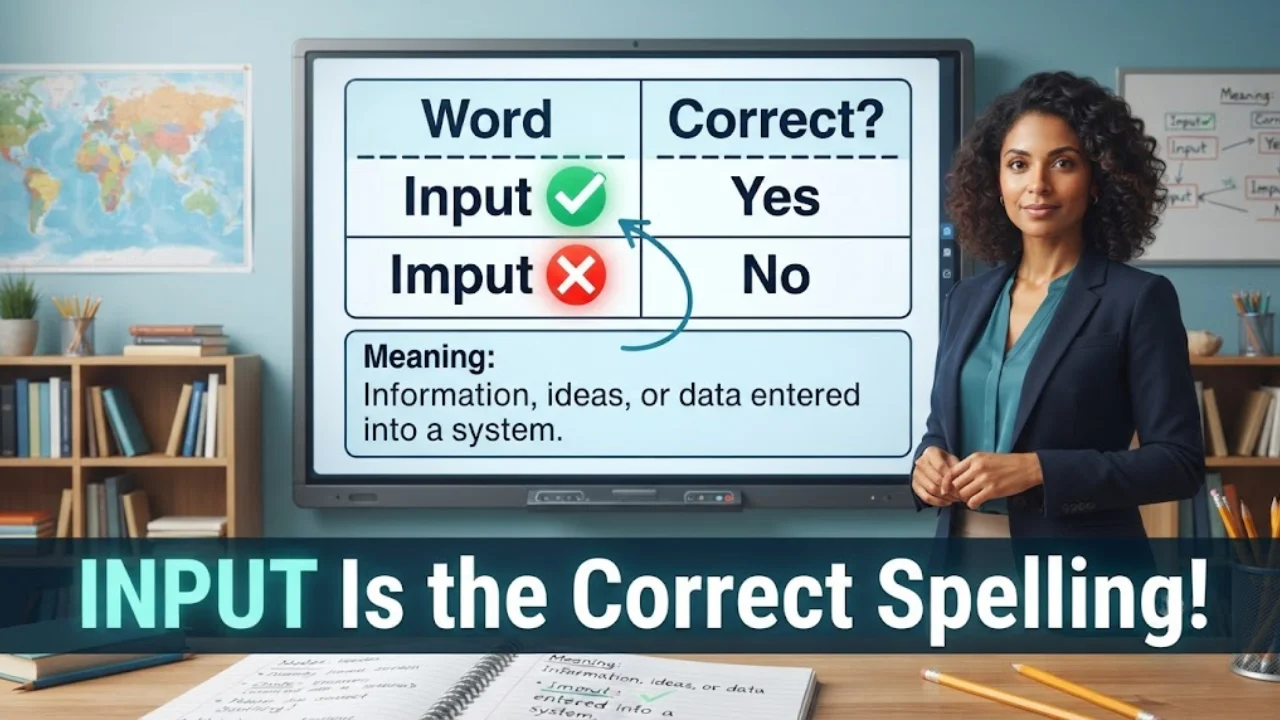
Here’s the short version: input is correct, and imput is not a real word. The rest of this guide breaks down why, where the confusion comes from, and how to use input the right way in business, tech, and everyday writing.
Input or Imput — The Quick Answer

Let’s settle this fast, since that’s likely why you’re here.
Is Imput a Real Word?
No. Imput does not appear in Merriam-Webster, Cambridge, or Oxford dictionaries. It’s a misspelling, plain and simple, not a regional variant or informal spelling choice. Every major style authority, including the AP Stylebook and the Chicago Manual of Style, treats it as an error.
Why Input Is Always Correct
Input is a compound word: in + put. Something goes in, so you put it in — that’s the whole logic. The spelling has stayed fixed since it entered English, and no dictionary lists an alternate form. If you remember nothing else, remember this: input keeps its “n,” always.
What Does Input Mean? (Definition and Word Origin)
Understanding the meaning makes the spelling easier to lock in.
Input as a Noun
As a noun, input means information, data, or a contribution added to a system, project, or conversation. “We need your input before Friday” simply means “we need your opinion or feedback.”
Input as a Verb
As a verb, input means to enter or feed data into something, usually a computer, form, or device. “Please input your password” is a direct instruction to type it in.
This dual role — noun and verb sharing one identical spelling — is called zero derivation in linguistics. English does this with plenty of words (think “email” or “text”), and it’s exactly why input never changes form no matter its job in a sentence.
Where the Word Input Came From
The word output actually predates input, showing up in mining and manufacturing contexts as early as the 14th century. Input followed later, gaining traction in engineering during the late 1800s to describe materials or energy entering a process. It exploded into everyday vocabulary during the 1940s computing boom, when engineers needed a short, precise term for data entering a machine. That technical root is still visible today in terms like input voltage, input device, and input validation.
Why Do People Write Imput Instead of Input?

This isn’t carelessness. There’s real linguistics behind the slip.
Phonetic Assimilation — Why N Sounds Like M
Say “input” out loud, quickly. Notice how the “n” softens toward an “m” sound before the “p”? That’s called assimilation, a natural shift where one sound adjusts to match the sound next to it. Your mouth is doing the work efficiently, but your fingers follow your ears — and that’s where the typo starts.
Keyboard Typos
On a standard keyboard, N and M sit right next to each other. Fast typing, autocorrect gaps, and muscle memory all combine to make “imput” an easy slip, especially on mobile keyboards with smaller keys.
Confusion With Impute
Here’s a distinction most guides skip over: impute is a real, different word. It means to attribute or assign blame to someone, often in legal or formal writing (“They imputed the delay to poor planning”). It’s not related to input in meaning, but the similar sound is likely part of why “imput” feels oddly familiar.
| Word | Real Word? | Meaning |
|---|---|---|
| Input | ✅ Yes | Data, feedback, or entering information |
| Imput | ❌ No | Misspelling of input |
| Impute | ✅ Yes | To attribute or assign blame |
How to Use Input Correctly (Examples by Field)
Input shows up everywhere in American English. Here’s how it functions across common settings.
Input in Business and Everyday Writing
“We value every team member’s input during planning meetings.” Here, input means opinion, suggestion, or contribution — a staple phrase in US workplace communication.
Input in Technology and Data Entry
“The system requires user input before processing.” In tech, input covers keystrokes, uploaded files, voice commands, or any data a user or sensor feeds into software.
Input in Economics, Education, and Science
In economics, input costs refer to raw materials or labor used in production. In education, “student input” shapes lesson planning. In science, an input can be a signal, chemical, or variable entering a system. The concept — something entering a process — stays consistent across every field.
Input vs Inputted — Correct Past Tense
Both forms are accepted, but usage differs slightly:
- “She input the numbers yesterday” — more common in American technical and business writing.
- “He inputted the data manually” — grammatically correct, slightly more explicit, used often in casual or conversational contexts.
Pick one and stay consistent. Most US style guides lean toward input as the simpler, more standard past-tense choice.
How to Never Misspell Input Again
A few small habits eliminate this error for good.
Simple Memory Trick
Break it down every time: IN + PUT = INPUT. Picture yourself literally putting something into a box, form, or machine. If the visual holds, the spelling holds too.
Real Examples of the Imput Mistake
A single typo can cost credibility. A marketing report sent to hundreds of clients with “we welcome your imput” reads as careless, even if the strategy behind it is solid. On a résumé, the same slip can signal weak attention to detail to a hiring manager scanning for reasons to reject a stack of applications.
Quick Self-Check List
- ❌ “Please imput your details” → ✅ “Please input your details”
- ❌ “Client imput matters” → ✅ “Client input matters”
- ❌ “I imputted the data” → ✅ “I input (or inputted) the data”
Tools like Grammarly, Microsoft Editor, and built-in Google Docs spellcheck all flag “imput” automatically — a quick pass through any of these catches the error before it reaches a reader.
FAQs
What is the difference between input and imput? Input is a correct, dictionary-recognized word meaning data, feedback, or the act of entering information. Imput is not a word at all — it’s simply a misspelling caused by how “input” sounds when spoken quickly.
What does your input mean? “Your input” means your opinion, feedback, or contribution to a discussion, project, or decision. It’s commonly used in meetings, emails, and collaborative work.
Is input a real word? Yes. Input is listed in every major English dictionary, including Merriam-Webster, Cambridge, and Oxford, and functions as both a noun and a verb.
Is it correct to say input? Yes, it’s always correct, in both American and British English, whether you’re using it as a noun (“your input”) or a verb (“input the data”).
Conclusion
One letter separates a polished message from a typo that undermines it. Input is the only correct spelling — as a noun, a verb, in tech, business, or casual conversation. Keep the mnemonic close: in + put = input, and the mistake won’t creep back in.

Timmy Baqir is the founder and lead content writer at CorrectGrammars.com, a website dedicated to helping writers of all levels master the English language with clarity and confidence.